The Word That Launched a Thousand Menus
Walk into any coffee shop in North America and you will see it on the menu: chai tea latte. Three words, two of which mean exactly the same thing. Chai is the Hindi word for tea. So when you order a “chai tea,” you are literally ordering a “tea tea.” And that chai tea latte? Tea tea with milk.
Sounds ridiculous when you put it that way, right?
It is not a crime — English is especially shameless about borrowing words and bending them beyond recognition. But here is the thing: understanding what chai actually means unlocks a much richer way of thinking about the drink sitting in your cup. It connects you to a history that stretches across continents, trade routes, and thousands of years of human culture. That cinnamon-heavy syrup pumped from a bottle at your local cafe? It is a footnote in a much bigger story.
The Linguistics: How “Chai” Traveled the World
So where did the word come from in the first place? The answer starts with a single plant.
The word for tea in most languages on Earth traces back to Camellia sinensis, the tea plant first cultivated in China’s Yunnan province thousands of years ago. From there, the word split into two distinct branches — and which one your language uses depends entirely on which trade route brought tea to your ancestors.
The Overland “Cha” Route
Tea traveled overland via the Silk Road to Persia, Turkey, Central Asia, Russia, and eventually India. Along this path, the Mandarin word cha morphed into chai in Hindi and Urdu, chay in Persian and Turkish, and chai in Russian. Here is a quick rule of thumb: if your country received tea by land, you probably call it some version of “cha.”
This is the route that matters most for our story. When tea arrived in India — likely sometime during the early centuries of trade along the Silk Road — it brought the word cha along with it. Over time, the Hindi-speaking population shaped that into chai, and it became so embedded in daily life that the word is practically invisible. Asking for chai in Mumbai is like asking for water. Nobody thinks of it as exotic or specific.
The Maritime “Tea” Route
Dutch traders shipped tea from the port of Amoy (now Xiamen) in Fujian province, where the local Min Nan dialect calls it te. That word became tea in English, the in French, tee in German, and te in Spanish. The pattern holds: if your country received tea by sea, you probably call it some version of “te.”
Why This Split Matters
So chai and tea are not two different drinks. They are two pronunciations of the same Chinese word, separated by trade routes and a few centuries of linguistic drift. When someone asks “what does chai mean?” — the honest answer is just “tea.” Nothing more, nothing less. The spiced latte version came much, much later.
What People Actually Mean When They Say “Chai”
This is where things get interesting, because the word means completely different things depending on which side of the world you are standing on.
Chai in India and South Asia
In India, if you ask for chai, you will get tea. Full stop. But what kind of tea? That depends entirely on where you are and who is making it.
- In Mumbai, you might get a strong, sweet CTC black tea with milk — no spices at all.
- In Kashmir, you could be served noon chai (also called shir chai), a pink-hued tea made with salt, baking soda, and crushed almonds.
- In Kerala, Sulaimani chai arrives black, brewed with lime juice, mint, and a touch of jaggery.
- In Rajasthan, your chai might come with a heavy hand of fennel and black pepper.
- In a street vendor’s stall anywhere, the classic masala chai — tea simmered with milk, sugar, and a handful of whole spices — is what most people picture.
The point is that chai is not one recipe. It is a category. An entire universe of regional preparation styles that vary from household to household, city to city, and state to state. Reducing it to a single flavor profile misses the forest for the trees.
Chai in the West
In the West, “chai” has become shorthand for masala chai specifically — the spiced, milky, sweet preparation that became popular in American coffee culture during the 1990s. Starbucks, Tazo, and Oregon Chai were among the brands that brought it mainstream, usually in the form of pre-made concentrates and powdered mixes.
That narrowing of meaning is exactly how the redundancy happened. Once “chai” started meaning “that spiced thing,” people needed to add “tea” to clarify it was a tea drink and not a spice blend, a candle scent, or an ice cream flavor. The irony is obvious, but it is also how language works. Meanings shift, and sometimes they shift in silly directions.
Want to know how the commercial version compares to the real thing? Our instant vs authentic chai breakdown lays out the differences in cost, taste, and ingredients.
What Makes Up a Traditional Masala Chai
Now that we have the linguistics sorted, let us talk about what actually goes into the drink most Westerners picture when they hear the word chai. Because even if the word just means “tea,” the spiced version deserves its fame.
Masala chai translates literally to “spiced tea.” The masala (spice mix) varies by household and region, but most versions build on a common foundation that has been refined over generations.
The Tea Base
Strong black tea — almost always an Assam CTC (crush, tear, curl) variety in India. CTC tea is processed specifically to create small, dense granules that brew fast and hit hard. That robustness is essential: the tea needs to hold its own against bold spices and whole milk without getting drowned out.
Delicate teas like Darjeeling or green tea would get absolutely steamrolled in this context. You need something with backbone, and Assam CTC delivers that in spades.
The Core Spice Blend
The five essential chai spices you will find in most masala chai across India:
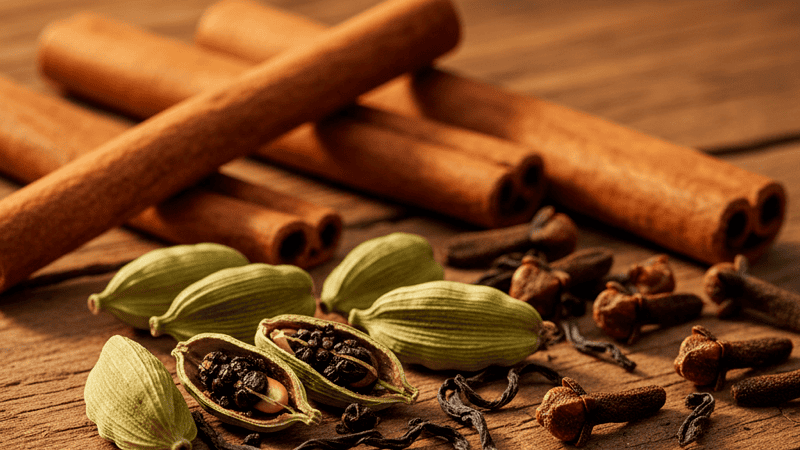
- Green cardamom — Floral, citrusy sweetness that many people consider the defining note of a good chai. Crack the pods open before adding them; the seeds inside hold the flavor.
- Fresh ginger — Sharp, peppery heat that provides warmth and aids digestion. Slice it thin or crush it with the flat of a knife for maximum extraction.
- Cinnamon — Gentle sweetness and warmth. Ceylon cinnamon is preferred for its delicate complexity, but cassia cinnamon (the more common grocery store variety) works too.
- Cloves — Deep, almost numbing warmth. Used sparingly — two or three per pot is plenty. Go overboard and they will hijack the entire cup.
- Black pepper — Subtle background heat that ties the blend together and enhances the bioavailability of other spice compounds.
Beyond these five, regional variations add fennel, star anise, nutmeg, bay leaves, or even saffron. There is no single “correct” masala chai recipe — and honestly, that is part of what makes chai culture so rich. If you want to learn how each spice contributes to the cup on a deeper level, our gateway spices guide breaks it all down.
The Brewing Method
Here is another thing that separates traditional masala chai from Western tea habits: it is not steeped. It is simmered.
The process goes like this:
- Crush your spices and add them to boiling water. Let them simmer for 3-5 minutes so the essential oils release fully.
- Add tea leaves and let them boil for another 2-3 minutes until the water turns a deep reddish-brown.
- Pour in whole milk (not skim — you need the fat for body and flavor) and bring everything back to a rolling boil.
- Strain and sweeten with sugar, jaggery, or honey to taste.
The whole process takes about 10 minutes. It fills your kitchen with a scent that no scented candle has ever managed to replicate. And the result — thick, fragrant, layered with spice — tastes nothing like the pre-made concentrates you find on store shelves. Our complete brewing guide walks through the step-by-step process with exact ratios.
The “Chai Flavor” Problem
Walk through the grocery store and you will find “chai-flavored” everything: granola bars, ice cream, protein powder, body lotion, even dog treats. (Yes, really.) But what do they actually taste like?
Almost all of them lean hard on cinnamon and vanilla — two flavors that are sweet, approachable, and familiar to Western palates. Some add a whisper of ginger or a hint of cardamom. Very few include cloves or black pepper.
The result is a “chai flavor” that would be unrecognizable to anyone who has actually had traditional masala chai in India. It is the culinary equivalent of calling ketchup “Italian food” because it has tomatoes in it. The word has been stripped of its meaning and repurposed as a vague aesthetic — warm, cozy, autumnal.
There is nothing wrong with enjoying a cinnamon-vanilla latte. But calling it “chai” does a disservice to the original. The real thing is bolder, more complex, and far more interesting.
If you are curious how chai stacks up against other trendy tea drinks, our chai vs matcha comparison puts both traditions side by side on caffeine, flavor, and health benefits.
Regional Chai Styles Worth Exploring
One of the best arguments against chai as a single flavor is the sheer diversity of how it is prepared around the world. Here are a few styles worth seeking out:
Kashmiri Noon Chai
Noon chai (also called shir chai or pink tea) is made with green tea leaves, milk, salt, and baking soda. The baking soda reacts with the green tea to produce a striking pink color. It is savory rather than sweet, often garnished with crushed pistachios or almonds. Completely different from anything you would find at a Western cafe, yet it is still just chai.
Sulaimani Chai from Kerala
Sulaimani is a black tea brewed with cardamom, cloves, and lime juice, sweetened with jaggery or honey. No milk at all. It is traditionally served after meals as a digestive and is a staple at weddings and celebrations in Kerala’s Malabar region. Light, citrusy, aromatic — the polar opposite of a heavy masala chai.
Turkish Cay
In Turkey, cay (the local version of “cha”) is black tea brewed in a double-stacked teapot called a caydanlik. The tea is strong and served in small tulip-shaped glasses with sugar cubes on the side. No spices, no milk. Turkish tea culture is built around the ritual of serving and sharing — cay is offered to guests, customers, and strangers alike. It is a social lubricant, not a beverage.
Russian Zavarka
Russian chai traditionally involves a strong tea concentrate called zavarka, brewed in a small pot and diluted with hot water to individual preference. Historically paired with a samovar and served with jam, lemon, or sugar. Again, no spices — just tea in its most direct form.
Each of these traditions calls the drink some version of “chai” or “cha.” None of them taste like a pumpkin spice latte with cinnamon on top.
Why This Matters Beyond Pedantry
Look, nobody is going to judge you for ordering a “chai tea latte.” Baristas understand what you mean, and language purists do not actually make the world a better place. But knowing that chai means tea — and understanding the cultural depth behind that simple word — changes how you approach the drink.
It means you stop treating chai as a novelty flavor and start seeing it as one of the oldest, most widespread beverage traditions in human history. It means you get curious about how a Kashmiri noon chai tastes versus a South Indian Sulaimani versus a Turkish cay. It means you understand why that bottled concentrate sitting in your fridge, while convenient, captures only a tiny fraction of what chai can be.
The next time you brew a cup, try doing it from scratch. Crack some cardamom pods, slice fresh ginger, toss in a cinnamon stick and a few cloves, and simmer it the way it has been made for generations. You will taste the difference — and you will understand why over a billion people just call it tea.