An Intervention, Delivered with Love
I need to talk to you about something. I have seen the mug. I have seen you pour leftover chai into it, open the microwave, punch in ninety seconds, and walk away. I have watched you take the first sip and accept it — not enjoy it, just accept it — the way someone accepts gas station coffee because they need the caffeine and have stopped expecting anything better.
You deserve better. Your chai deserves better. And the fix takes three minutes on a stove instead of ninety seconds in a microwave. That is a ninety-second investment in actually enjoying your drink instead of just tolerating it.
If you have ever wondered why microwaved chai tastes bad — why it goes from vibrant and fragrant to flat and lifeless after ninety seconds in the microwave — the answer is chemistry. And once you understand it, you will never nuke your chai again.
Let me explain what is actually happening during that glorious stovetop boil, why the microwave cannot replicate it, and how to reheat chai on the stove without destroying everything that made it good in the first place.
What Happens When Chai Boils on the Stove
The stovetop boil is not just about getting the liquid hot. It is a controlled chemical event where three things happen simultaneously, and all three are essential to what makes chai taste like chai. Skip any of them and you get something lesser — drinkable, maybe, but not the same.
Tannin Extraction and Integration
When tea and water boil together, the rolling motion continuously circulates the liquid across the tea leaves, pulling tannins out evenly. Tannins are polyphenolic compounds that provide body, astringency, and color. They are what make chai feel substantial in your mouth rather than thin and watery.
But here is the part that matters for reheating: tannins extracted during a boil integrate with the milk proteins and spice oils in the pot. They bind to casein proteins in the milk, which is exactly why chai does not taste as astringent as plain black tea despite being boiled aggressively. The milk tames the tannins. The tannins give the milk weight. They need each other, and the rolling boil is what introduces them.
Without that boil, you have tannins and proteins coexisting in the same liquid but not actually bonded. It is the difference between a sauce that has been emulsified and one where the oil is just floating on top. Same ingredients, completely different result.
Milk Protein Denaturing
When milk reaches a rolling boil in the chai pot, the whey proteins (primarily beta-lactoglobulin) begin to denature — they unfold from their compact structures and interact with casein micelles and fat globules. This changes the texture of the liquid in a way that is impossible to replicate with gentle heating.
You know that slightly thicker, almost silky mouthfeel that separates a great cup of chai from a mediocre one? That is denatured milk protein at work. The proteins create a micro-network that traps fat droplets and spice compounds, giving the liquid a cohesive richness that you can actually feel on your tongue.
The boil also triggers a mild Maillard reaction between the milk sugars (lactose) and proteins, producing those subtle caramelized, toasty notes that sit underneath the spice. It is the same class of reaction that makes browned butter taste different from melted butter. You cannot rush it, and you cannot fake it with a microwave.
Ever noticed how the best chai has a faintly golden, almost toffee-like sweetness that does not come from sugar? That is the Maillard reaction at work. It only happens at boiling temperatures with sustained contact between milk sugars and proteins.
Spice Oil Release and Emulsification
The essential oils from your spices — cardamom’s terpinyl acetate, ginger’s gingerol, cinnamon’s cinnamaldehyde, clove’s eugenol — are released during simmering. But during the final rolling boil with milk, those oils become emulsified into the fat phase of the liquid.
Think of it like a vinaigrette. Oil and water do not mix on their own. But agitate them vigorously in the presence of an emulsifier (in this case, milk proteins and lecithin from the milk fat), and they form a stable suspension. The rolling boil provides that vigorous agitation. The spice oils become evenly distributed throughout the liquid instead of floating on top or clinging to the pot walls.
This is why properly boiled chai delivers spice flavor in every sip, not just the first one. And it is why authentic stovetop chai tastes so fundamentally different from the instant powder versions — the emulsification cannot happen without a real boil.
Why the Microwave Produces Flat Chai
Now let us talk about what actually happens when you nuke your chai for ninety seconds. Spoiler: almost nothing good.
Uneven Heating Destroys Consistency
Microwaves heat liquid unevenly. The electromagnetic waves create standing wave patterns inside the oven cavity, producing hot spots and cool zones throughout the liquid. Some areas reach near-boiling while others stay lukewarm. There is no circulation, no rolling motion, no convective mixing. The liquid just sits there getting unevenly warm.
What does that mean for your chai? The flavor compounds are not being redistributed. Whatever settled to the bottom of the mug stays at the bottom. Whatever rose to the top stays at the top. The spice oils that separated during cooling remain separated. You get a sip of scalding, slightly bitter liquid near the rim and a sip of lukewarm, flat liquid halfway down.
Have you ever noticed how microwaved chai tastes different with each sip? That is uneven heating. Every milliliter of the mug is at a different temperature with a different concentration of flavor compounds. It is chaos in a cup.
No Rolling Boil Means No Re-Emulsification
The rolling boil is where everything comes together, and the microwave simply cannot produce one. Even if you blast the mug long enough to get the liquid bubbling, it is a chaotic, localized boil at the edges — not the sustained, full-volume convective boil you get on a stove.
Why does this matter specifically for reheating?
- No convective circulation means no re-emulsification of spice oils that have separated during storage. Those oils are sitting in droplets on the surface or clinging to the mug walls, and they are going to stay there.
- No sustained high heat means no additional Maillard reaction to refresh the caramelized milk notes. What you brewed yesterday is as good as it is going to get — the microwave cannot add anything.
- The milk proteins, already denatured once during the original brew, do not benefit from reheating at all. They just break down further, producing that slightly “cooked” or stale taste that microwaved milk always has. If you have ever microwaved a glass of plain milk and tasted it, you know exactly what I mean — that flat, slightly sulphurous note. Your chai is getting that same treatment.
Volatile Compound Loss
Many of the aromatic compounds that make chai smell incredible — the ones that hit your nose before the cup reaches your lips — are volatile. They evaporate easily. During a stovetop brew, these compounds are continuously being generated as the spices simmer, so the loss is offset by new production.
In the microwave, there is no new production. The spices are not in the mug. You are just reheating a finished product, and every second of heating drives more volatile aromatics out of the liquid and into the air inside the microwave.
The result is chai that smells like almost nothing and tastes like a memory of itself. You know what I mean — you open the microwave door and get a blast of spice-scented air. That smell? That was supposed to be in your cup. It is in the air now. Gone.
The 3-Minute Stovetop Reheat That Actually Works
Here is how to reheat chai on the stove and bring leftover chai back to life. It takes three minutes and one small saucepan. If you can boil water, you can do this.
The Method
- Pour your leftover chai into a small saucepan. Scrape out any settled spice residue from the mug — that is flavor you want back in the liquid, not waste to leave behind.
- Add a splash of fresh milk. About two tablespoons per cup. This is the secret weapon. Fresh milk gives the proteins something to work with and replaces some of the fat that has oxidized during storage.
- Heat over medium flame. Stir once or twice as it warms. You will see the separated oils start to reincorporate as the liquid moves.
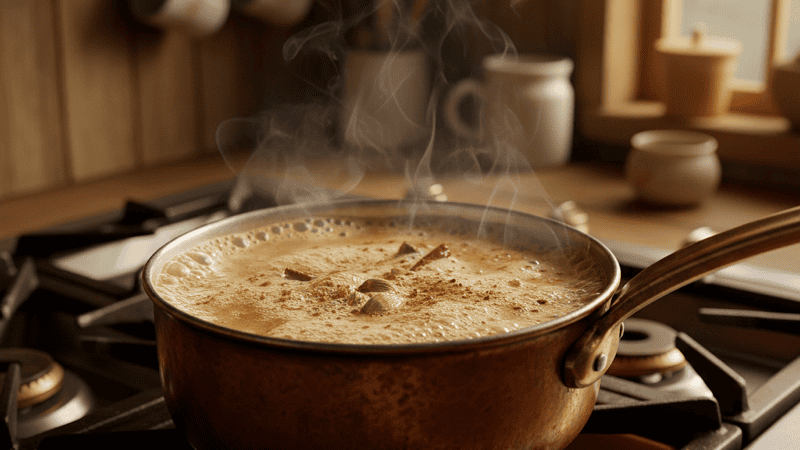
- Bring to a single rolling boil. Let it rise up the sides of the pan, then immediately cut the heat. One good boil is enough. You are not re-brewing — you are re-emulsifying and refreshing.
- Pour and drink immediately. Do not let it sit around cooling in the pan. The whole point is capturing that freshly-boiled integration.
That is it. Three minutes. The difference between this and the microwave version is so stark that it feels unfair. The stovetop reheat produces chai that tastes about eighty percent as good as fresh. The microwave produces something that tastes like it has given up on life.
Why the Splash of Fresh Milk Is the Key
Old chai loses body because the milk proteins have fully denatured and the fat has started to oxidize. Oxidized milk fat has a stale, slightly cardboard-like taste that no amount of heat can fix.
But fresh milk introduces new proteins and fat that reinvigorate the texture. The new proteins bind with the existing tannins. The new fat picks up spice compounds that had separated out. One rolling boil mixes everything back together. It is like adding a fresh egg to day-old pasta dough — it revitalizes the whole thing.
Two tablespoons is not much, but it makes a world of difference. Do not skip it.
A Note on the Boil-and-Drop Technique
When you bring the chai to a rolling boil, the foam will rise rapidly toward the rim of the pan. The moment it threatens to overflow, drop the heat. Let the foam subside. Then bring it back up once more.
This rise-and-fall cycle is the same technique used in a fresh brew, and it serves the same purpose: the turbulent motion emulsifies the fats and oils back into suspension. One cycle is enough for a reheat. Two is better if you have an extra thirty seconds.
If you want to understand why this boil technique matters so much for fresh chai too, our guide to brewing mistakes breaks down the science.
When to Just Make a Fresh Pot
Let us be honest — the reheat method is for leftover chai that you made too much of, not for chai that has been sitting in the fridge since last weekend. Here is the rule of thumb:
- Same day, within a few hours: Stovetop reheat works beautifully. This is the ideal use case. The spice oils have not had time to degrade significantly, and one good boil brings everything back together.
- Next morning, stored in the fridge overnight: Still works, but add a little extra fresh milk (three tablespoons instead of two) and give it a slightly longer boil. Expect about seventy percent of the original flavor. Still miles better than microwaved.
- Two or more days old: Make a fresh pot. The spice oils have degraded, the milk has picked up fridge flavors, and no amount of reheating will fix that. Life is too short for stale chai. Our brewing guide takes ten minutes — just start over.
How to Store Leftover Chai Properly
If you know you are going to reheat chai later, how you store it matters almost as much as how you reheat it.
- Cool it quickly. Do not leave the pot sitting on the counter for hours. Rapid cooling preserves more volatile aromatics. Pour the leftover chai into a container and get it into the fridge within thirty minutes.
- Use a sealed container. Chai absorbs fridge odors like a sponge. That leftover onion soup on the second shelf? Your chai will taste like it by morning. Glass jars with tight lids work best. Avoid plastic if possible — it can absorb and retain spice odors from previous uses.
- Do not strain out the spice residue before storing. Leave whatever sediment settles in the bottom. Those particles continue to infuse very slowly during cold storage, and they reintegrate during the reheat boil. Free flavor.
The Case for Brewing Just Enough
The best solution to the reheating problem is not needing to reheat at all. If you find yourself regularly microwaving leftover chai, you are probably making too much per batch.
A single serving of stovetop chai needs just half a cup of water and half a cup of milk. That is one small saucepan, one cup of chai, ten minutes of your time. Make exactly what you will drink right now.
If you are cooking for two, double it. For four, get a bigger pot. But resist the temptation to make a full pot “just in case.” Fresh chai is always better than reheated chai, no matter how good your reheat technique is.
If you want to have chai available throughout the day without reheating, consider making a homemade chai concentrate instead. You brew a strong spice-and-tea base, store it in the fridge, and add hot milk to order. It is a completely different approach that sidesteps the reheating problem entirely.
What About Chai Lattes? Same Rules Apply
If you are reheating a chai latte from a coffee shop — the kind with steamed milk and chai syrup — the same principles apply, just with lower stakes. Coffee shop chai lattes are usually made from concentrate or syrup rather than a fresh boil, so there is less complexity to lose in the first place.
That said, even a syrup-based latte benefits from stovetop reheating over microwaving. The milk still separates, the sweetener still settles, and the microwave still heats unevenly. A quick stovetop warm with a stir will taste noticeably better.
But if you are drinking syrup-based chai lattes and wondering why they do not taste as good as real masala chai, that is a different conversation entirely.
The Bottom Line on Microwaved Chai
The microwave is a brilliant invention. It reheats rice beautifully. It melts butter in seconds. It makes leftover pizza passable at two in the morning. But it cannot boil, it cannot emulsify, and it cannot reproduce the rolling convective chaos that makes chai taste like chai.
Three minutes on a stove. A splash of fresh milk. One good boil. That is all it takes to treat your chai with the respect it earned the first time you brewed it. Your taste buds will notice the difference immediately, and you will wonder why you ever settled for the microwave version in the first place.
Put the mug down. Pick up the saucepan. Your chai will thank you — and so will everyone in your house who has to smell what microwaved milk does to a kitchen.