The Equipment Myth That Keeps People from Brewing Chai
Somewhere along the way, people got the idea that making good chai at home requires special equipment. Maybe it is the influence of coffee culture, where you apparently need a $300 grinder and a $600 espresso machine before you are allowed to enjoy a cup. Maybe it is the specialty tea industry selling cast-iron teapots and temperature-controlled kettles. Either way, the message is the same: spend money before you start.
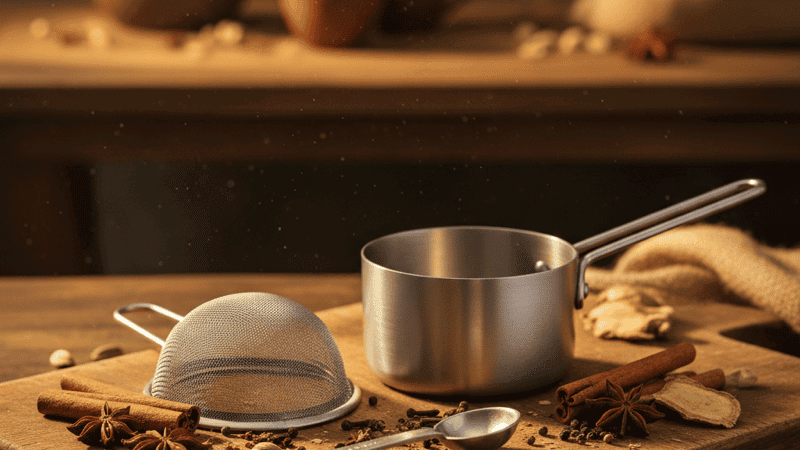
Here is the truth. Over a billion people make chai every single day across South Asia, and the vast majority of them use exactly three things: a pot, a strainer, and a spoon. That is it. No gooseneck kettles. No infuser baskets. No digital thermometers. A chaiwallah on a Mumbai street corner produces better chai than most Western tea shops, and his entire chai making setup fits inside a plastic crate.
So why do so many beginners assume they need to invest in gear before their first cup? Because the internet is littered with “essential tools” listicles written by people who want you to click affiliate links. I fell for it myself when I started out — bought a cast-iron teapot that looked beautiful on the counter and was completely useless for actual chai brewing.
You can replicate a proper budget masala chai brewing setup for under ten dollars. I am going to show you exactly how.
The Three-Item Chai Kit for Beginners
Everything you need to start brewing real masala chai at home fits in one hand. No Amazon wish lists required.
1. A Small Saucepan ($3-5)
Any small saucepan between 1 and 2 quarts works. Stainless steel is ideal because it does not react with the tannins in black tea or the acids in spices. But honestly, whatever you already have in your kitchen is fine. Check thrift stores if you want something dedicated — small saucepans show up there constantly because everyone owns too many.
Why small? Because chai is simmered, not brewed in bulk. You want the spices, tea, and milk to concentrate together in a tight space where they can mingle properly. A big stockpot spreads everything too thin and the flavors never develop the same intensity. Think of it like a reduction in cooking — the smaller the vessel relative to the liquid, the more concentrated the result.
I once tried making chai in a large Dutch oven because I wanted to serve eight people. The spice flavor was so diluted it tasted like vaguely warm milk with a cinnamon suggestion. Lesson learned. For group servings, make multiple small batches rather than one huge one.
2. A Fine Mesh Strainer ($2-3)
You need something to catch the tea leaves, spice fragments, and ginger pieces before they end up in your cup. A basic fine mesh strainer — the kind you would use for powdered sugar or sifting flour — works perfectly. You can find these at any dollar store, grocery store, or Indian market.
Do not bother with tea infuser balls or those novelty silicone infusers shaped like animals. Seriously, skip them. They restrict the movement of tea leaves and spices, which means weaker extraction and a thinner cup. You want everything loose in the pot, swimming freely while it simmers, and then caught by the strainer when you pour. This is the same reason professional chefs do not cook soup in a tea bag — ingredients need room to move and release their flavor compounds.
A fine mesh strainer also doubles as a kitchen tool you will use for a dozen other purposes. Sifting flour, straining stocks, draining small batches of pasta. It earns its two dollars back many times over.
3. A Measuring Spoon ($1-2)
One standard teaspoon measure. That is all. You need consistent measurements when you are learning ratios, and eyeballing is how people end up with chai that tastes different every single time. How much tea did I use yesterday? Was it one heaping spoon or two level ones? That uncertainty produces inconsistent results and frustration.
Once you have made fifty pots and developed an intuition for proportions, go ahead and freehand it. My grandmother never measured anything and her chai was flawless every time. But she also had forty years of practice. Until you build that muscle memory, measure.
Total cost: $6-10. You probably own at least two of these already.
Where to Buy Chai Spices (and Why It Matters)
The kit is only half the equation. You also need spices, tea, and milk. Here is where most beginners overpay dramatically, and it has nothing to do with quality.
The Indian Grocery Store Advantage
If you have an Indian, Pakistani, or South Asian grocery store anywhere within driving distance, go there first. The price difference is genuinely staggering. A jar of whole green cardamom pods at a mainstream supermarket costs $8-12 for a tiny amount. The same quantity at an Indian grocery store costs $3-5, and the quality is usually better because the turnover is higher — those spices are not sitting on a shelf for months collecting dust.
Same story with black tea. A box of Assam CTC — the strong, granular tea that forms the backbone of every good chai — costs a few dollars for 500 grams at an Indian store. That is enough for well over a hundred cups. Buying “chai-grade black tea” from a specialty tea retailer will cost you five times as much for essentially the same thing with fancier packaging and a story about the estate it came from.
Do not know where to find an Indian grocery store near you? Search for “Indian grocery” or “South Asian market” on Google Maps. In most mid-size American cities, there is at least one within a reasonable drive. Many also sell online now if you are in a more rural area.
Your Starter Spice List
Here is what to buy for your first batch of chai, with approximate costs at an Indian grocery store:
- Assam CTC black tea (250g box) — $2-3
- Green cardamom pods (small bag, ~50g) — $3-4
- Fresh ginger root (one knob) — $0.50-1
- Cinnamon sticks (small pack) — $1-2
- Whole cloves (small bag) — $1-2
- Black peppercorns (small bag) — $1-2
Total spice investment: roughly $9-14. And every one of those items will last you dozens of cups, except the ginger — you will need to buy that fresh each week. If you are not sure what each of these spices does or how much to use, our gateway spices guide covers all five in detail, including the science behind why each one matters.
That means your complete startup cost — equipment plus spices — is around $15-24 for your entire chai kit. Compare that to buying a $6 chai latte at a cafe every morning. The kit pays for itself in three days.
A Note on Spice Freshness
Here is something most beginner guides skip: spices go stale. Whole spices stay potent for about a year if stored in airtight containers away from heat and light. Pre-ground spices lose their punch in three to six months. This is another reason to buy whole spices and crack or crush them yourself right before brewing — you get the full aromatic impact rather than a faded version of it.
If your cardamom pods do not smell intensely fragrant when you crack them, they are too old. If your cinnamon sticks smell like nothing when you snap them, replace them. Fresh spices are the single biggest factor in whether your chai tastes extraordinary or just okay. The difference between authentic chai and the instant versions starts right here with spice quality.
Your First Brew: A Step-by-Step Beginner Chai Recipe
You have the kit. You have the spices. Let me walk you through your very first pot. Do not overthink this — the process is forgiving and the worst-case outcome is still a drinkable cup of tea.
Ingredients (Two Cups)
- 1.5 cups water
- 3-4 green cardamom pods, cracked with the flat of a knife
- 1-inch piece of fresh ginger, sliced into thin coins
- 1 small cinnamon stick, snapped in half
- 2 whole cloves
- 3 black peppercorns, cracked
- 2 teaspoons Assam CTC black tea
- 1 cup whole milk (or full-fat oat milk)
- Sugar or honey to taste
Method
-
Add the water and all the spices to your saucepan. Bring to a boil over medium-high heat, then reduce to a simmer. Let the spices bubble gently for 3 minutes. Your kitchen will start smelling incredible at about the 90-second mark — that is the cardamom’s essential oils hitting the steam.
-
Add the tea leaves. Stir once, reduce heat slightly, and let it simmer for another 3 minutes. The water should turn a deep reddish-brown. If it still looks pale, give it another minute. CTC tea leaves are small and granular, so they release color and flavor faster than loose leaf varieties.
-
Pour in the milk. Stir and bring everything back to a gentle boil. Watch it carefully — milk boils over fast and makes a mess you will not enjoy cleaning. I speak from extensive personal experience on this one. When the liquid rises toward the rim, cut the heat immediately.
-
Strain into two cups using your mesh strainer. Sweeten to taste. I like one teaspoon of sugar per cup, but start with half and adjust. Some people use honey, jaggery, or condensed milk. There is no wrong answer here — sweetness is personal.
That is it. Ten minutes, three pieces of equipment, and you have a cup of homemade masala chai that would genuinely embarrass most of what gets served in cafes. No $40 tea set required. No subscription box. No “chai concentrate” from a bottle.
Common First-Timer Mistakes (and How to Avoid Them)
A few things to watch for on your first few attempts. Every single one of these is a mistake I made myself at some point:
-
Using pre-ground spices. Whole spices release their oils slowly during simmering, which is exactly what you want. Pre-ground spices dump all their flavor in the first thirty seconds and then taste flat and papery. If you want to understand the difference between authentic and instant approaches, it starts right here at the spice level.
-
Skipping the simmer. Chai is not steeped like English tea. The spices need sustained heat to release their essential oils — those volatile compounds that give chai its depth and complexity. If you just pour hot water over everything and wait, you get tea-flavored water with some floaty bits in it. That is basically the same problem as microwaving chai.
-
Using skim milk. Fat carries flavor. This is basic food science, not opinion. Skim milk produces thin, watery chai that no amount of sugar can save. Whole milk is the standard. Full-fat oat milk is the best non-dairy option I have found — its natural sweetness complements the spices beautifully.
-
Overcomplicating it. Your first pot does not need star anise, fennel, saffron, or rose petals. Start with the basic five spices, learn what they taste like together, and add complexity later once you understand the foundation. Fancy additions like floral elements are great — after you have the basics down.
-
Boiling too aggressively. A gentle simmer extracts flavor cleanly. A rolling boil makes the tea bitter and can scorch the milk. Keep the heat at medium-low once the spices are in the water. Patience is the only skill this recipe requires.
The Real Cost of Daily Chai at Home
Let me do some quick math that might change your morning routine.
A daily chai latte from a cafe runs about $5-6. Over a month, that is $150-180. Over a year, you are looking at north of $1,800 for something that usually comes from a syrup pump and a steam wand — not real spices, not simmered, not anything close to what you can make at home.
A daily cup of homemade chai costs roughly $0.40-0.60 in ingredients. Even if you replace your ginger weekly and restock spices every couple of months, you are spending maybe $15-20 a month on better chai than any cafe serves. That is an annual savings of over $1,500.
Here is the breakdown per cup:
- Tea leaves: ~$0.05
- Spices (cardamom, cinnamon, cloves, pepper): ~$0.15
- Fresh ginger: ~$0.05
- Milk (1/2 cup whole): ~$0.15
- Sugar: ~$0.02
Total per cup: roughly $0.42. Compare that to $5.50 for a medium chai latte at most cafes. You are paying thirteen times more for an inferior product.
And the ten-dollar kit? It lasts basically forever. A saucepan does not expire. A strainer does not wear out. The measuring spoon will outlive you and probably your grandchildren.
Upgrading Your Kit Over Time
Once you have been brewing for a month or two and you are confident in the basics, a few inexpensive upgrades can make the experience even better:
-
A mortar and pestle ($5-8). Freshly crushed cardamom and cracked peppercorns release more aromatic oils than knife-cracked versions. A small marble or granite mortar is a satisfying tool to use and makes your kitchen smell amazing before the water even hits the pot.
-
A dedicated chai pot ($8-15). In India, many households have a small pot used exclusively for chai. Over time, the metal absorbs spice oils and develops a subtle seasoning that adds depth to every batch. It is the chai equivalent of a well-seasoned cast-iron skillet.
-
A milk frother ($10-15). Not traditional at all, but frothing the milk before adding it to the strained chai creates a cafe-style presentation that feels luxurious. Nice for when you want to make your afternoon cup feel special.
None of these are necessary. They are upgrades for when you have the basics dialed in and want to explore. The $10 kit does everything you actually need.
Where to Go from Here
Once you are comfortable with the basics — once you can make a solid pot of chai without thinking too hard about the steps — the entire world of chai brewing opens up. Try adding a star anise pod. Experiment with different ratios of ginger to cardamom. Brew it stronger and add a shot of espresso for a dirty chai. Make it the centerpiece of a daily afternoon ritual that resets your brain after a long morning.
Want to explore chai traditions from other parts of the world? Sulaimani chai from Kerala skips the milk entirely for a citrusy, black tea version. The Thai iced tea connection reveals surprising overlaps between chai and Southeast Asian tea culture. And if you are wondering whether your new chai habit might be better for you than your old coffee habit, the answer might surprise you.
But all of that starts here. One pot. One strainer. One spoon. Ten dollars. Go make some chai.