The $6 Problem Nobody Talks About
You know the drill. You’re standing in line, already running late, and you order that chai latte because you deserve it. Then the barista pumps four squirts of something from a bottle that looks suspiciously like caramel sauce. Six dollars later, you’re sipping what is essentially spiced sugar milk.
Here’s the thing most people don’t realize: that “chai” at your local coffee chain has almost nothing in common with real masala chai. The base is typically a pre-made concentrate heavy on sweeteners, with some black tea and spice extracts mixed in. Nobody is steeping fresh tea leaves to order. No fresh ginger. No cracked cardamom. It’s a flavored latte wearing a chai costume.
But you can make the real thing at home in about 10 minutes, for roughly 50 cents a cup. And honestly? It will taste dramatically better than anything you’ve been paying six dollars for.
I started making my own masala chai recipe at home about three years ago, mostly out of frustration. I kept ordering “chai lattes” that tasted like liquid cinnamon rolls. Sweet, one-dimensional, and nothing like the chai my friend’s Indian grandmother used to make when I visited their house after school. That kitchen smelled like warmth itself. No pump bottle was involved.
What Coffee Shops Get Wrong About Chai
Most Western coffee shops treat chai as a flavoring, not a preparation method. They use pre-made syrups or powdered mixes because it’s faster and more consistent across locations. The problem? Authentic masala chai depends on fresh spices blooming in hot water and milk — a process you simply cannot replicate with a pump bottle.
The Sugar Trap
A typical coffee shop chai latte contains around 40-50 grams of sugar per serving. That’s more than a can of Coca-Cola. The sweetness masks the fact that there’s barely any spice complexity underneath. You’re tasting sugar and vanilla, not ginger and cardamom.
Want to know what’s actually in those concentrates? A typical ingredient list starts with a water-and-tea infusion, followed by cane sugar and honey — sweeteners make up a huge portion of what you’re drinking. While some concentrates do list individual spices like cardamom and cloves, they also lean on “natural flavors” to round things out. If you’ve ever wondered why your chai tastes like spicy water, this is usually the answer.
The Freshness Factor
Real masala chai gets its character from volatile compounds in whole spices. Gingerol in fresh ginger, 1,8-cineole in cardamom, eugenol in cloves — these aromatics are fragile. They break down quickly once the spice is ground, and they degrade even faster in a sugary syrup sitting on a shelf for weeks. By the time that pump hits your cup, most of the interesting flavor chemistry is long gone.
That’s why even “premium” chai lattes from specialty shops rarely come close to what you can make on your stove in ten minutes with whole spices.
The 10-Minute Authentic Masala Chai Recipe
This is the homemade chai recipe I make almost every morning. It serves two generous mugs or three smaller cups. The whole process takes about 10 minutes from cold pan to poured cup.
Ingredients
- 2 cups water
- 1 cup whole milk (or oat milk for a dairy-free version)
- 2 tablespoons loose black tea (Assam CTC works best)
- 1-inch piece fresh ginger, roughly smashed
- 4 green cardamom pods, lightly crushed
- 1 small cinnamon stick (Ceylon if you can find it)
- 3-4 whole cloves
- 2-3 black peppercorns
- Sugar or honey to taste (start with 1 tablespoon)
The Method
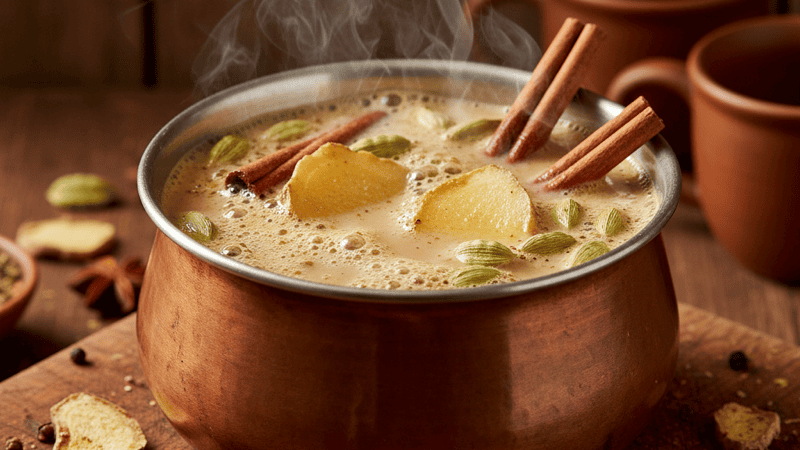
Step 1: Bloom the spices (2-3 minutes). Add water, ginger, cardamom, cinnamon, cloves, and peppercorns to a saucepan. Bring to a rolling boil and let it go for 2-3 minutes. You want the kitchen to start smelling incredible — that’s the volatile oils releasing into the water. Don’t rush this step. The spice bloom is what separates a good cup from a great one.
Step 2: Add the tea (2 minutes). Drop in the loose tea leaves and boil for another 2 minutes. The water should turn a deep reddish-brown. This is where the tannins develop — that robust backbone that no syrup can replicate. If you’re using CTC Assam, you’ll notice the color changes fast. That’s by design. Those tiny granules extract efficiently.
Step 3: Add the milk and pull (3-4 minutes). Pour in the milk and bring everything back to a boil. Watch the pot here — milk boils over fast and makes a mess you’ll regret. Let it rise, reduce heat, let it rise again. Do this 2-3 times. This “pulling” technique is what gives chai its creamy, frothy texture. It’s not just tradition for the sake of it. The repeated boiling aerates the liquid and allows some water to evaporate, concentrating the flavors and creating a richer body that stirring milk into tea after the fact can never achieve.
Step 4: Sweeten and strain. Add your sugar, give it a final stir, and strain into your favorite mug through a fine mesh strainer. Drink it while it’s hot. Masala chai doesn’t wait around.
A Note on Tea Selection
Why Assam CTC and not, say, Earl Grey or English Breakfast? It comes down to structure. CTC (Crush, Tear, Curl) tea leaves are specifically manufactured for milk tea preparations. They release tannins and color quickly, and their bold, malty flavor stands up to milk and spices without disappearing.
Whole-leaf teas are lovely for other preparations, but they tend to get lost in masala chai. The spices and milk overpower their subtlety. Save your single-estate Darjeeling for a quiet afternoon — your masala chai wants the muscle of CTC.
The Side-by-Side: Coffee Shop vs. Homemade
How does the copycat chai latte recipe stack up against what you’ve been buying? Let’s break it down:
| Coffee Shop Chai | Homemade Masala Chai | |
|---|---|---|
| Cost | $5-7 per cup | ~$0.50 per cup |
| Sugar | 40-50g (fixed) | You control it |
| Spices | Syrup flavoring | Whole, fresh spices |
| Caffeine | Varies wildly | Consistent with your tea |
| Time | 5 min (plus the line) | 10 minutes |
| Monthly cost | $130+ (weekday habit) | ~$25-30 |
| Customization | Limited | Infinite |
The cost difference alone is hard to ignore. But the flavor gap is what really seals it. Once you taste chai made with whole spices simmered in milk, the syrup version starts to feel like a completely different drink. Because it is.
Tips for Nailing Your Masala Chai Every Time
Smash Your Ginger, Don’t Slice It
Use the flat side of a knife to crush fresh ginger. This ruptures the cell walls and releases more gingerol and other volatile oils than neat slices ever will. You want jagged, broken pieces — not pretty coins.
Don’t Skip the Boil-and-Rise
I mentioned this already, but it’s worth repeating because it’s the single most common mistake. The repeated boiling with milk isn’t just tradition — it aerates the chai and concentrates the flavors as water evaporates, creating that signature creamy body. It’s the difference between “tea with milk in it” and actual chai. If you’ve been microwaving your chai, this step is especially important to understand.
Adjust Your Spice Ratios to Your Taste
The recipe above is a starting point, not a rule. Some people want more ginger heat. Others love extra cardamom. Here’s a rough guide for adjustments:
- More warming: Add an extra cinnamon stick or 2-3 more peppercorns
- More floral/aromatic: Double the cardamom pods to 8
- More heat: Use a larger piece of ginger (1.5-2 inches)
- More depth: Add a single star anise or 2 allspice berries
- Sweeter without sugar: Try a small piece of jaggery or a splash of condensed milk
Curious about which spices do what? Our gateway spices guide breaks down the flavor profile of each one.
Make a Batch Concentrate
Here’s the real time-saver. Double or triple the spice-and-water step, strain out the spices, and store the chai concentrate in the fridge. It keeps for about a week. Then you just heat concentrate with milk each morning — takes about three minutes. Even faster than driving to the coffee shop.
This is also a great strategy if you want to build a chai kit on a budget. Buy your spices once, prep in bulk, and you’re set for weeks.
The Annual Math That Changes Your Mind
Let’s get specific about the savings, because the numbers are genuinely surprising.
If you buy one $6 chai latte five days a week, that’s $1,560 a year. Let’s look at what the homemade version costs:
- Assam CTC tea (250g bag): ~$8 (lasts about 6 weeks of daily use)
- Green cardamom (50g): ~$6 (lasts about 2 months)
- Fresh ginger: ~$1/week
- Cinnamon sticks, cloves, peppercorns: ~$10 combined (lasts 3-4 months)
- Milk: ~$4/week
Total annual cost for weekday homemade masala chai: roughly $300-350 per year (including milk).
That’s over $1,200 back in your pocket — and you’re drinking something that actually tastes like real chai, with whole spices you can see and smell. Even if you upgrade to premium single-estate Assam or splurge on high-grade green cardamom from Guatemala, you’d still come in well under $500 annually.
What would you do with an extra $1,200? Serious question.
Common Mistakes to Avoid
Using pre-ground spices. Ground cardamom and ground ginger can lose a significant amount of their potency within a few months of opening — some sources estimate up to 60% within the first three months. Whole spices keep their volatile oils locked inside until you crack them open. The flavor difference is night and day.
Boiling for too long. More than 5 minutes of total tea boiling makes your chai bitter and astringent. The tannins go from pleasantly robust to mouth-puckering. Two minutes of tea boiling is the sweet spot.
Adding milk too early. The spices need time in plain water first. Milk fat and proteins can interfere with the extraction of water-soluble spice compounds, resulting in a weaker spice flavor. Always bloom your spices in water before the milk goes in.
Using skim milk. Fat carries flavor. Whole milk (or full-fat oat milk) gives your chai that rich, creamy body. Skim milk makes thin, watery chai that’s not worth the effort. If you’re cutting calories, use less sugar instead.
Ready to Go Beyond the Basics?
Once you’ve nailed this masala chai recipe, the world opens up. Try adding a pinch of saffron threads during the spice bloom — it turns the chai golden and adds a subtle honeyed complexity. Or swap the cinnamon stick for a star anise and watch how it shifts the whole character of the cup.
If you want to explore regional variations, our guide on Sulaimani chai covers a completely different approach — a spiced black chai from Kerala with no milk at all. And if the espresso-meets-chai trend appeals to you, check out our dirty chai guide or learn what dirty chai actually is.
You could also experiment with floral additions like rose and lavender, or build an afternoon chai ritual that turns your daily cup into something more intentional.
The best masala chai you’ll ever have won’t come from a coffee shop. It’ll come from your own kitchen, on a Tuesday morning, while the rest of the world is still standing in line. And once you taste the difference, you won’t go back.